
Importing vanilla, spices, cocoa or coffee from Madagascar is about more than choosing a good product. A missing or incorrect document can hold a container at customs, cost you a tariff preference or delay a delivery your customers are waiting for. Here are the documents that accompany a shipment from Madagascar, and the points to agree with your exporter before the goods leave.
Before shipment: setting the ground rules
Choosing the Incoterm
The Incoterm defines when risks and costs pass from seller to buyer. For agricultural products shipped from Madagascar, the most common are:
| Incoterm | The seller covers… | Best for |
|---|---|---|
| FOB | Goods loaded on board at the port of departure (often Toamasina) | Buyers who manage their own sea freight |
| CFR | Plus freight to the destination port | Simplifying transport arrangements |
| CIF | Plus cargo insurance | Buyers who want an insured port-delivered price |
| FCA / CPT / CIP | Variants suited to air freight and consolidation | Vanilla and small, high-value volumes |
The chosen Incoterm, its version (Incoterms 2020) and the exact named place should appear on both the contract and the invoice.
Approving the specification and the sample
The specification sheet (quality, grade, moisture, packaging, labelling) and the approved sample are your reference if a dispute arises. They are signed off before shipment, never after.
Commercial and transport documents
🧾 Commercial invoice
Seller, buyer, goods, tariff code, quantities, price, Incoterm. It is the basis for calculating duties and taxes.
📦 Packing list
Details of packages, gross and net weights and lot numbers.
🚢 Bill of lading / AWB
The contract of carriage. An original bill of lading is also a document of title and governs release of the goods.
Origin and sanitary documents
Proof of origin
Madagascar applies an Economic Partnership Agreement (EPA) with the European Union. When the rules of origin are met, Malagasy products can enjoy preferential access to the EU market, on presentation of the proof of origin provided for in the agreement, notably the EUR.1 movement certificate.
💶 A direct impact on your landed cost
Without valid proof of origin, the tariff preference is lost. Request and check it for every shipment, before the goods arrive.
Phytosanitary certificate
Issued by Madagascar’s plant protection services after inspection, it certifies that plant products meet the importing country’s sanitary requirements, where that country requires it for the product concerned.
Certificate of analysis (COA) and safety data sheet
The COA sets out the lot’s test results: moisture, active compound content (vanillin, essential oil, etc.), microbiological criteria and contaminants. Essential oils also come with a safety data sheet (SDS / MSDS), since they are subject to specific transport and labelling rules.
Organic documents
To sell under the EU organic label, each lot must be covered by the operator’s certificate, issued by its control body, and by a certificate of inspection (COI) issued in the EU TRACES system before release for free circulation. Without it, the goods cannot be sold as organic, even if they were produced to organic standards.
In importing, product quality is not enough: it is the quality of the paperwork that gets goods delivered on time, at the right cost and under the right label.
New traceability requirements
Cocoa and coffee fall under the EU Deforestation Regulation (EUDR). Under the application timetable in force, operators placing them on the EU market must file a due diligence statement backed by plot geolocation. An exporter working directly with identified growers and cooperatives is best placed to provide that information.
✅ The importer’s checklist
- Signed contract: Incoterm, specification and payment terms;
- Approved sample, kept on file;
- Commercial invoice and packing list consistent with each other;
- Bill of lading or AWB with the correct consignee and notify party;
- Proof of origin (EUR.1 or equivalent) to claim tariff preferences;
- Phytosanitary certificate where required;
- Certificate of analysis for the lot, plus SDS for essential oils;
- Organic certificates and TRACES COI for organic products;
- Traceability data for cocoa and coffee.
Frequently asked questions
Sea or air freight: which should I choose?
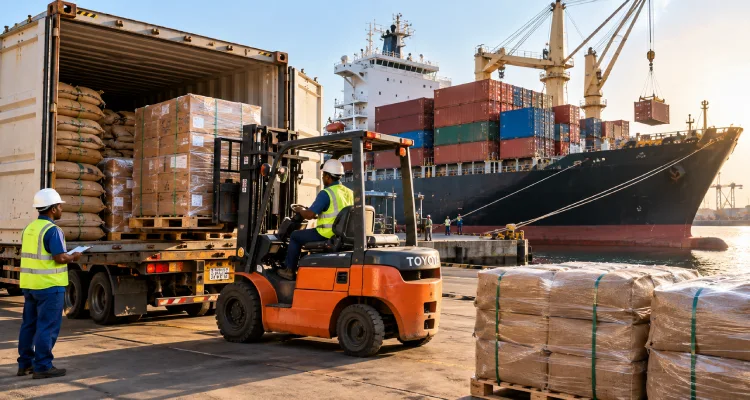
Sea freight remains the most economical for large volumes (cocoa, coffee, cloves, cashew). Air freight makes sense for high-value, low-volume products such as vanilla or some essential oils, or for urgent needs.
Who handles customs clearance on arrival?
Generally the importer or its customs broker. The exporter handles export clearance in Madagascar and sends all the necessary documents in advance so that import clearance goes smoothly.
Can I track my shipment?
Yes. The bill of lading or AWB number lets you track the vessel or flight, and a reliable exporter keeps the customer informed at each stage: loading, departure, transhipment and arrival.
Further reading
Planning to import from Madagascar?
EKL Export handles export documents, phytosanitary certificates, laboratory testing and shipment tracking to Europe, Asia and the Middle East. Let’s talk about your project.