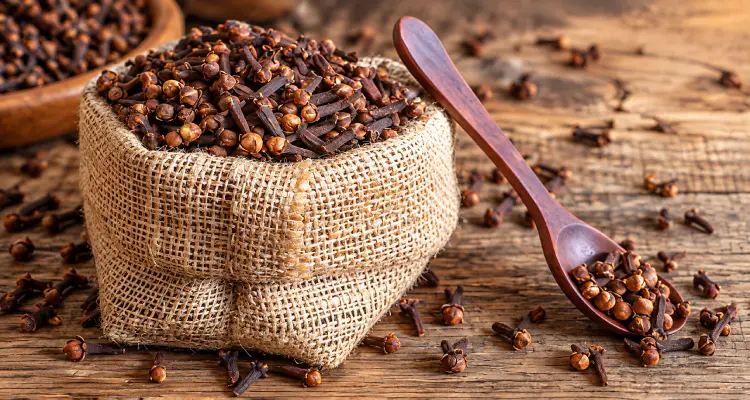
Warm fragrance, peppery flavour, a lingering finish: Madagascar cloves are among the spices most prized by food manufacturers and distillers. The island ranks among the world’s leading exporters, and its east coast holds smallholder know-how passed down through generations. Origin, harvest, quality criteria, buying tips: here is your guide to sourcing with confidence.
A spice born on Madagascar’s east coast
The clove tree (Syzygium aromaticum) has adapted perfectly to the hot, humid climate of Madagascar’s eastern seaboard. The Analanjirofo region, whose name literally means “the forest of clove trees”, accounts for most of the production around Fénérive-Est, Soanierana-Ivongo, Mananara and Sainte-Marie island.
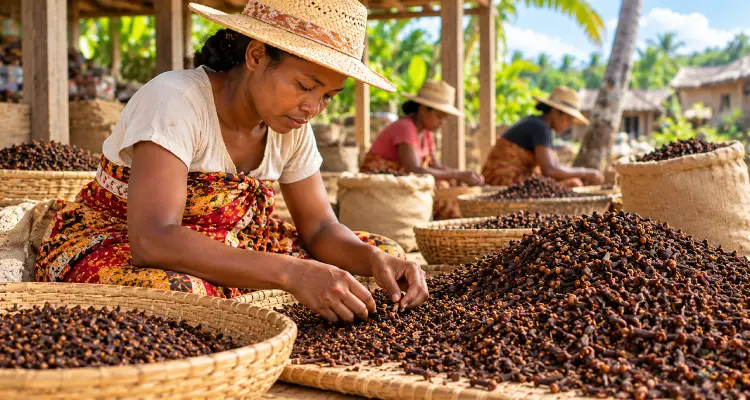
Trees are grown on small family plots, often alongside food crops. This smallholder model has a direct consequence for buyers: final quality depends less on the plot than on the care taken during harvesting, drying and sorting. That is exactly where the exporter makes the difference, supervising collection and checking every lot before shipment.
From picking to the export bag, in 4 steps
1. Picking the flower buds
A clove is the closed flower bud of the clove tree. It is picked by hand just before it opens, as it turns from green to pink. Volumes vary noticeably from one season to the next: clove trees naturally alternate between bumper and leaner years.
2. Destemming
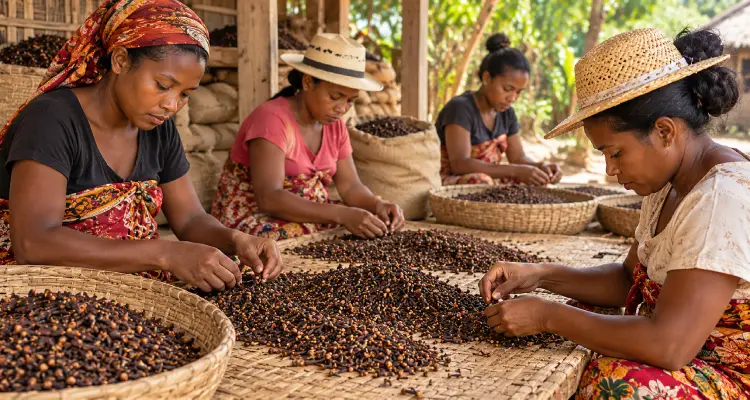
The buds are separated from their stems. This manual step determines the purity of the lot: stems left among the cloves lower the grade and the aromatic strength. Nothing goes to waste, though: the stems are used for distillation.
3. Sun drying
Spread out on mats or clean drying floors, the cloves turn brown over several days. Drying that is too short leaves moisture that encourages mould; drying poorly protected from rain or bare ground spoils the appearance and introduces impurities. A well-dried clove is dark brown, brittle and keeps a well-formed head.
4. Sorting, grading and packing
Before export, lots are sorted to remove headless cloves, fragments, stems and foreign matter. They are then graded, packed in clean bags suited to sea freight and labelled to guarantee traceability.
Quality criteria to check
A clove purchase contract relies on a small number of parameters. These are the ones to put in your specification sheet and then find on the lot’s certificate of analysis:
| Criterion | Why it matters |
|---|---|
| Moisture content | Drives shelf life: above the contractual limit, mould becomes a risk |
| Headless cloves and fragments | Determine the lot’s commercial grade |
| Stems and foreign matter | Measure the cleanliness and purity of the lot |
| Essential oil content | Reflects aromatic strength (eugenol) |
| Appearance and colour | An even brown, with no bleached or damaged cloves |
| Food safety compliance | No mould, and compliance with destination-market limits (mycotoxins, residues) |
💡 The fingernail test
Press a clove with your fingernail near the stem: a good-quality clove leaves a slight oily trace. A dry, odourless clove has either been poorly stored or already distilled.
Many end markets, from the kitchen to aromatherapy
- Food industry and fine food retail: whole or ground cloves, spice blends, cured meats, gingerbread, mulled wine;
- Distillation: clove bud, stem and leaf essential oils, sought after for their high eugenol content;
- Cosmetics and perfumery, which love warm, spicy notes;
- Asian markets, where cloves are used in particular to make certain flavoured cigarettes.
A good clove has an intact head, an even colour, and releases a drop of oil when pressed.
5 habits that secure your supply
Alternating crops, weather and Asian demand make the clove market volatile. These good practices reduce the risk:
- set a precise specification sheet (grade, moisture, tolerances) before any negotiation;
- ask for a sample that represents the actual lot, not a generic type sample;
- require a certificate of analysis for each lot and the phytosanitary certificate;
- plan purchases early in the season, when supply is widest;
- favour an exporter who works directly with growers and traces the origin of every lot.
Frequently asked questions
When is the best time to buy Madagascar cloves?
The first lots of the new crop reach the market at the end of the year. Committing early in the season gives you a wider choice and better control over quality. Our seasonality calendar helps you plan.
How should cloves be stored after delivery?
In a dry, cool, ventilated area away from light, in the original packaging or in airtight containers. Whole cloves keep their aroma far longer than ground cloves.
Can cloves be supplied as organic?
Yes, if the supply chain is certified from end to end. The control body’s certificate and the certificate of inspection (COI) must then accompany every shipment to the European Union.
Further reading
Planning a clove purchase?
EKL Export sources its cloves from partner growers on the east coast and checks every lot before shipment. Get a specification sheet and a sample.