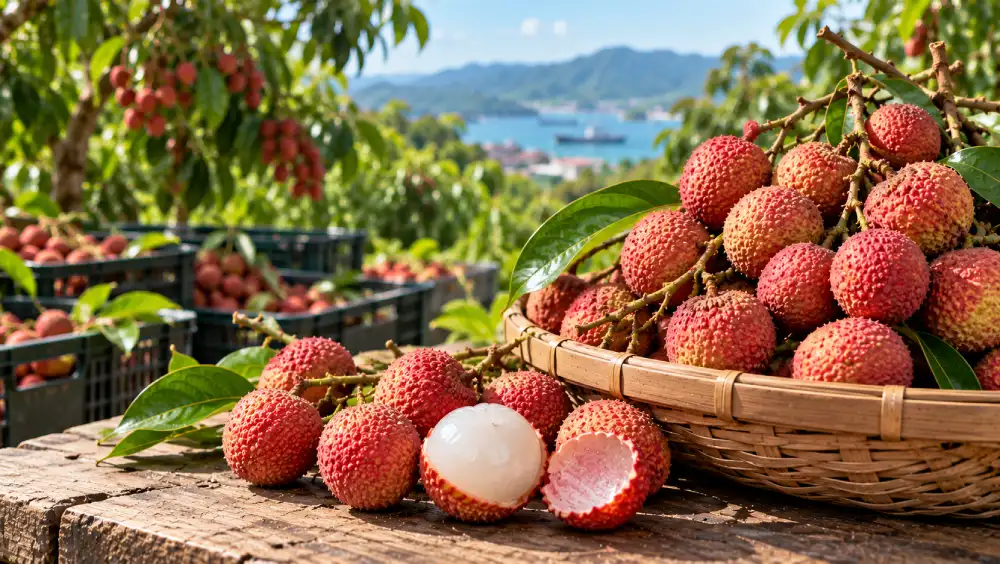
Every year-end, Madagascar lychees reach European shelves just in time for the holidays. Behind this annual event lies an intense export season lasting only a few weeks, where everything depends on ripeness, freshness and logistical speed. Timing, quality, transport, formats: here is everything an importer needs to know.
A seasonal fruit, a very short season
Lychee (Litchi chinensis) is grown mainly on Madagascar’s east coast, in the regions of Toamasina, Fénérive-Est, Brickaville and Manakara further south. The trees, often old, belong to thousands of smallholders who sell their crop to collectors and then to packing stations.
Harvest starts from mid-November and most exports take place through January. The season is regulated by the authorities and the industry: opening dates, shipment organisation and quality checks all aim to protect the origin’s reputation.
Sea or air: two supply chains, two markets
🚢 Sea freight
Most of the volume. Lychees travel under controlled refrigeration, on reefer ships or in reefer containers, to reach Europe before the holidays.
✈️ Air freight
The first fruit of the season and premium ranges, sometimes sold on the branch. More expensive, but the fruit is only days from the tree.
Why are lychees treated with sulphur?
Once picked, lychees brown very quickly: the red skin turns brown within days, even though the flesh stays good. For long sea journeys, the industry uses sulphuring to stabilise the skin colour. This treatment is strictly regulated: the fruit must comply with the residue limits set by EU regulations, which laboratory tests verify.
💡 “Unsulphured” lychees
For customers who prefer it, air freight makes it possible to offer unsulphured lychees: their skin browns faster, but their freshness is remarkable.
Quality criteria to check
| Criterion | What to expect |
|---|---|
| Size | Uniform within the box, in line with the stated class |
| Colour | Bright red, with no marked browning |
| Soundness | No split, crushed or mouldy fruit |
| Taste | Juicy, sweet, fragrant flesh |
| Compliance | Residues within regulatory limits, phytosanitary documents in order |
Beyond fresh fruit: frozen purées and juices
The fresh fruit season is short, but lychees can be processed into frozen purées or juices, available all year round for ice cream makers, pastry chefs and beverage brands. A good way to enjoy the aroma of Malagasy lychees out of season, with consistent quality.
With lychees, quality is measured in days: between the tree and the plate, every step must be ready before the season begins.
Frequently asked questions
When should I book my volumes?
As early as possible before the season opens, ideally by the end of summer: transport and packing capacity is limited.
How should lychees be stored on arrival?
Chilled, in their packaging, and sold quickly. Avoid temperature swings, which speed up browning.
Which documents come with a shipment?
Including the phytosanitary certificate, certificate of origin and transport documents. See our article Importing from Madagascar: the export documents you need.
Further reading
Get ready for the lychee season now
EKL Export supports importers with fresh Madagascar lychees and frozen purées: volume booking, quality control and logistics all the way to arrival.